

Meenikunno — A Bog to Experience Autumn with All Your Senses
Meenikunno wears a different face in every season. In spring, the bog awakens to birdsong. In summer, wetland plants flourish beside the boardwalk, while winter snow may blanket the bog pools and pines alike. Autumn brings its colours into focus: the reds and browns of low-growing shrubs, golden patches of sphagnum moss, and dark pools nestled among them. On chilly mornings, mist may drift over the lakes, while migrating geese, common cranes and whooper swans pause here on their journey. Even if you have visited before, autumn gives you a reason to return: a familiar trail takes on new colours, scents and sounds.
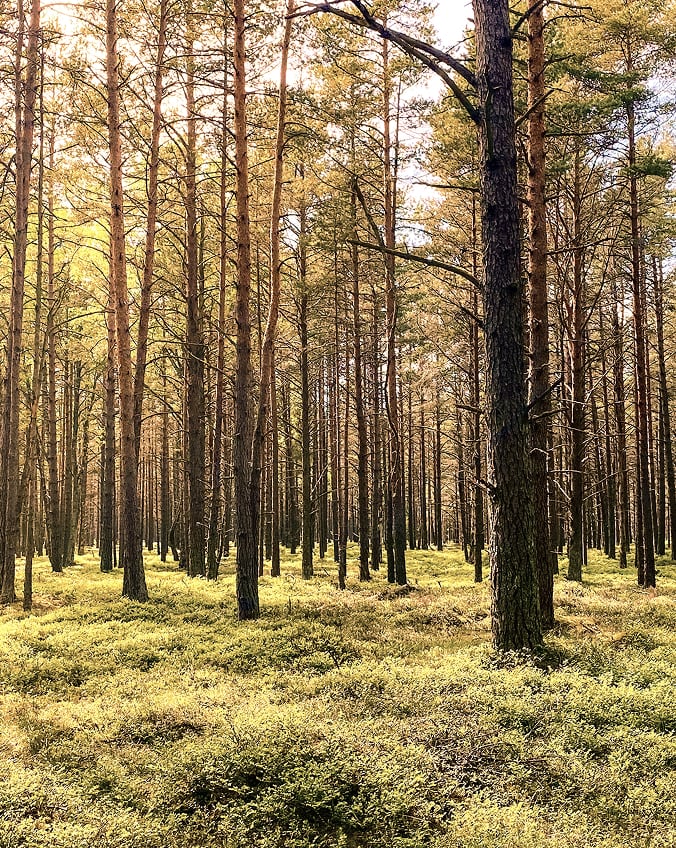
Meenikunno Bog lies in southeastern Estonia, in Räpina municipality in Põlva County, near the border with Võru County. The walking trail leads from pine woodland onto a boardwalk across the bog before returning through the forest. Along the way are bog lakes, stunted pines and wooded islands. Even a first visit offers a glimpse of just how varied a bog landscape can be.
The 5.8-kilometre circular trail includes 2.4 kilometres of boardwalk across the bog and 3.4 kilometres of forest paths. There is an observation tower at the Liipsaare end and 13 information boards along the route. You can start at either the Liipsaare or Päikeseloojangu car park. If you do not have time for the full circuit, simply follow the boardwalk out and back. When water levels rise in autumn, be prepared for wet forest paths if you choose the full loop. Then again, that is part of the charm of a walk in the bog.
An Ancient Road Beneath the “Hanging Bog”
Meenikunno began to form more than 8,000 years ago. Its southwestern section developed as an ancient body of water gradually filled with vegetation, but across most of the area, peat began accumulating directly on sand. Beneath the waterlogged peat lies a drier layer, with groundwater deeper below. This is why Meenikunno is sometimes described as a “hanging bog”: an expression that reflects its unusual structure and the movement of water beneath it.
There is a story behind the name Meenikunno, too. According to an account recorded in 1940, kund or kunnus referred to a patch of scrubland surrounded by bog, and the first person to settle there was said to have been called Meeni. This is a folk explanation rather than an established origin of the name. Even so, it offers a sense of how long people have known these bog islands and the routes between them.
Today’s boardwalk is not the only known route through Meenikunno. Around 1890, work on the bog’s main drainage ditch uncovered well-preserved pine logs, seven to eight metres long, buried in the peat. Local tradition spoke of a military road built from logs, leading from a bog island towards the forest between Mustjärv and Valgjärv. The road was associated with the Swedes, although neither its age nor its purpose has been conclusively established.
Forests Within the Bog
Meenikunno Bog covers approximately 1,448 hectares. Wooded stretches alternate with waterlogged hollows, forested bog islands and larger bog lakes, including Kamarusjärv, Keskmine Suujärv and Suur Suujärv. The wider Meenikunno Nature Reserve covers nearly 3,028 hectares, protecting the surrounding forests, the Nohipalu lakes and an area of distinctive glacial hills known as kames.
The boardwalk reveals only part of this landscape. With local walking guides, you can also discover Pähnisaar, Tuksisaar, Mikusar, Krantsisaar and Pikksaar, as well as smaller, unnamed bog islands. These are patches of higher, drier ground, supporting woodland quite different from the wetland around them. Pähnisaar, one of the larger islands, is covered in lush birch and aspen woodland.
For local people, the forests around Meenikunno are also familiar places to gather berries and mushrooms. In autumn, visitors arrive with walking boots and baskets alike. The bog, its islands and the surrounding woods offer plenty of reasons to return, even when you have walked the boardwalk circuit several times.
If you would like to experience Meenikunno beyond the usual trail, head out with a local walking guide, such as Taavi from Metsik Retk. With him, your route may lead to bog islands where you can see the wet ground give way to forest, only for the bog to begin again at the island’s edge. A local guide knows the stories of the place, notices details you might otherwise walk past, and reveals a different side of Meenikunno.
Nearby, Nohipalu Valgjärv and Mustjärv are well worth a visit. Valgjärv has exceptionally clear, nutrient-poor water, while Mustjärv’s water is dark brown and acidic. The contrast between these two neighbouring lakes is immediately visible. Their connection to the bog is less apparent: Valgjärv’s water level depends in part on water flowing underground from the margins of Meenikunno.
A Place to Cherish and Protect
Meenikunno was placed under protection in 1981. The nature reserve includes several conservation zones that safeguard sensitive habitats and places where rare plants and birds live. Its forests and wetlands are home to capercaillie, black grouse and osprey. Protected plants found here include Austrian pleurospermum and creeping lady’s-tresses, while water lobelia and lake quillwort grow in Valgjärv. Walkers may never notice all these species, yet they are part of what makes this landscape so valuable for nature conservation.
There is still work to do to improve the bog’s condition. Old drainage ditches, already marked on maps from the 1930s, continue to carry water away. In 2025, Estonia’s State Forest Management Centre (RMK) presented a plan to restore more natural water conditions across approximately 478 hectares of bog and surrounding wet forest.
We recommend starting your walk at Liipsaare. This also brings you past Nohipalu Valgjärv and Mustjärv, both lovely places to pause along the way.
Meenikunno is a place to return to, time and again. Every season reveals something new, but the bog itself is in no hurry.
And when we come here, neither need we be.
Photos: Taavi Nagel


