
Leevaku chimney
The village of Leevaku, where the Võhandu River meets the Tartu–Räpina road, has been home to a whole succession of industries over the past two hundred years. In an age when machines drew their greatest power from a dammed-up river rather than from oil or coal, both flour mills and sawmills were built here; wool was carded, textiles were woven for the army, and later electricity was generated.
The river was also a waterway — and a far faster and more efficient one than the roads of the day. Below the dam the Võhandu is wide enough that, between the wars, a steamboat carrying people and goods ran between Leevaku and Räpina.
There is also plenty of clay around Leevaku, and so, in the early 1920s, it was decided to build yet another industry here — a brick factory. The new works were on such a scale that they could have become one of the most powerful brick-making enterprises in all of Estonia — by output of building bricks it would have been able to supply the entire country. The goods would have reached customers by water: by steamboat to Räpina, from there by barge to Lake Peipus, and up the Emajõgi to Tartu.
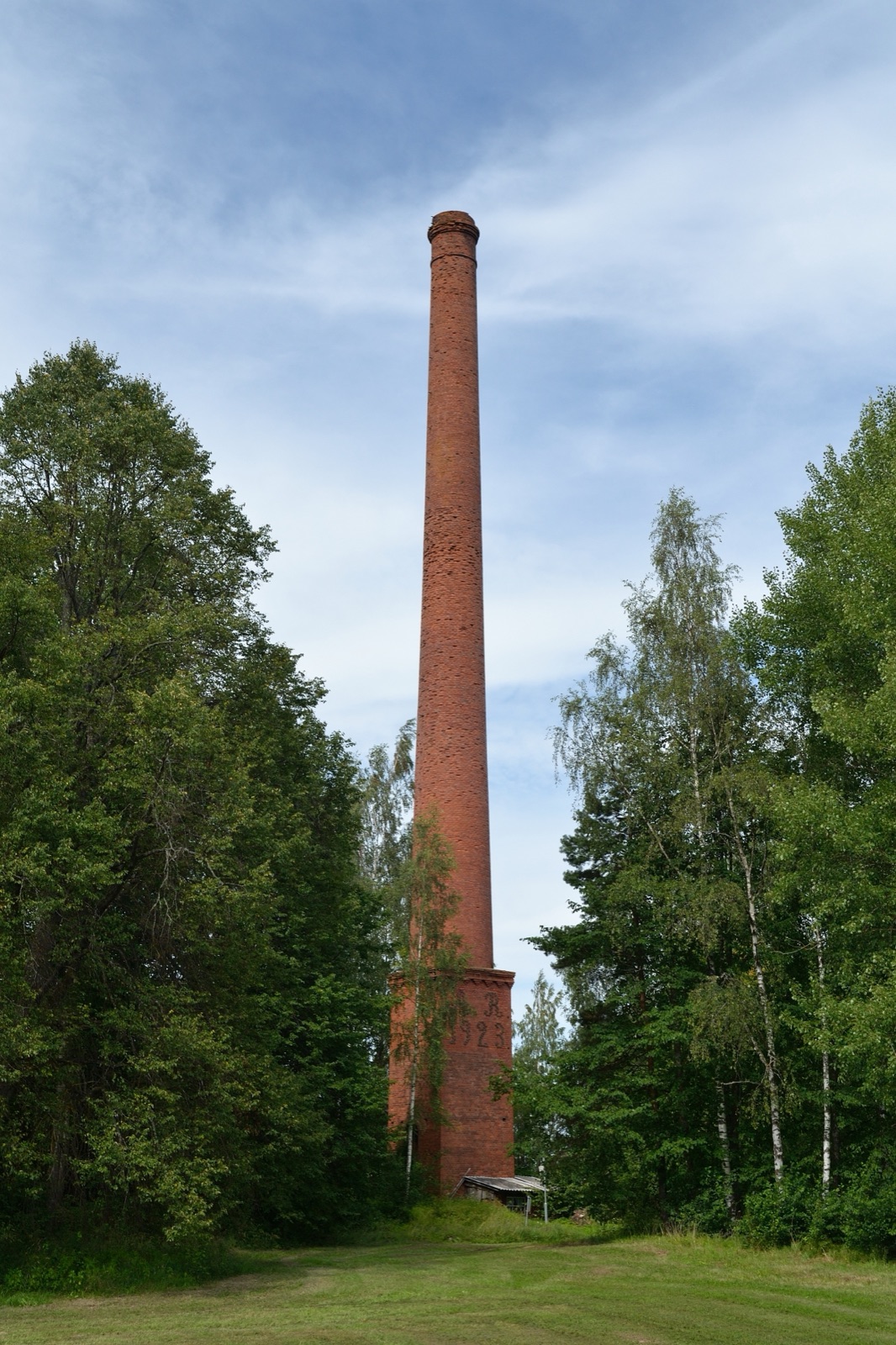
The factory was indeed completed, driven by the energetic locals Artur and Alide Reinomägi. Construction cost millions of marks and the works became an impressive landmark — its 50-metre chimney rises above the treetops and can be seen from afar even today, although the factory itself went bankrupt within just two or three years.
The reason for the venture’s dramatic and rapid collapse lay in the composition of the clay around Leevaku — it was not suited to making bricks. Leevaku clay contains particles of limestone, which caused lime blowouts in the bricks (known locally as „põrgulised“). How such a crucial detail was given too little attention in the business plan is hard to grasp in hindsight, especially as the Reinomägis had already run a smaller brickworks for ten years in the neighbouring village of Toolamaa.
The monumental chimney, however, still stands as a protected cultural monument, carrying the initials A and R of the Reinomägis worked into its brick pattern — according to local lore, the mighty chimney was raised not only out of practical necessity but also in the name of the couple’s love. Today the monument has found new use as the world’s tallest sauna chimney, serving a small sauna built right beside it. It is now owned by energetic locals who plan to spruce up the monument in their care and welcome all courteous visitors to come and take a closer look for themselves.
Leevaku is worth visiting for other reasons too. As Ülle, the chimney’s present-day keeper, puts it — besides the chimney, Leevaku has a hydroelectric station and the village picnic spot on the bank of the Võhandu River, with a sandstone outcrop as its backdrop — it is like their very own Taevaskoda: a lovely resting place for every traveller, where you can camp, swim, fish and enjoy the murmur of the water.
Photo: Ivar Leidus, Wikimedia Commons, CC BY-SA 3.0 ee
